

This article provides a comprehensive walking guide through Kalemegdan and Belgrade Fortress, highlighting key sights and experiences.
- Explore the main gates and viewpoints of Belgrade Fortress.
- Enjoy a leisurely walk that takes 2-3 hours at an easy pace.
- Discover historical landmarks like the Victor monument and Military Museum.
Kalemegdan is often reduced to a quick stop at the Victor monument, but the park and fortress complex reward a slower walk. A route through the main gates, viewpoints and hidden corners offers a fuller look at Belgrade Fortress, with time to rest, take photographs and notice details that many visitors miss.
This suggested walk can be completed in around two to three hours at an easy pace. If you want to add indoor visits, especially to the Military Museum or Nebojša Tower, allow more time.
Kalemegdan and Belgrade Fortress are not the same place
For visitors unfamiliar with Belgrade, it helps to know that Kalemegdan usually refers to the park around Belgrade Fortress, while the fortress itself includes the Upper and Lower Towns, gates, towers and ramparts. The distinction matters because the park is only part of the story.
A good starting point is the end of Knez Mihailova Street, with a short detour along the Sava Promenade before heading toward the main entrance to the fortress.
1. The Sava Promenade
The walk can begin with a pause on the Sava Promenade, where the view opens toward the Sava River, New Belgrade and Zemun. It is one of the most open points on the route and a good place to slow down before entering the fortress proper.
For photographs, it works best if you include part of the promenade or a branch in the foreground, rather than focusing only on the river and sky. It is also one of the better places for a longer rest on a bench.
2. The Stambol Gates
From the park, continue toward the Outer and Inner Stambol Gates, then the Clock Gate. This section is more than a passageway, as the route gradually leads you through layers of walls and changes in direction that show how the fortifications were designed.
It is worth turning around after passing through each gate, because the same entrance looks different from both sides. A stone arch can also help frame the scene beyond it for a stronger photograph.
3. The Clock Gate and Clock Tower
The Clock Tower is one of the easiest landmarks to use for orientation, but the gate beneath it deserves attention too. The gate is older than the tower, and inside the passage a surviving section of an earlier vault built from thin bricks can still be seen.
Visitors often look up at the clock and miss the structure under their feet. Looking both inside and from the approach gives two very different views of the same place.
4. The Military Museum
The Military Museum stands along the approach to the Upper Town and can take up a large part of a day if you decide to go inside. For a shorter walk, it is enough to pause nearby and decide whether you want to continue with the grounds or save the museum for another visit.
If the museum is part of your plan, check its current opening hours in advance. That is the practical choice for anyone trying to fit the fortress into a limited schedule.
5. The Victor monument
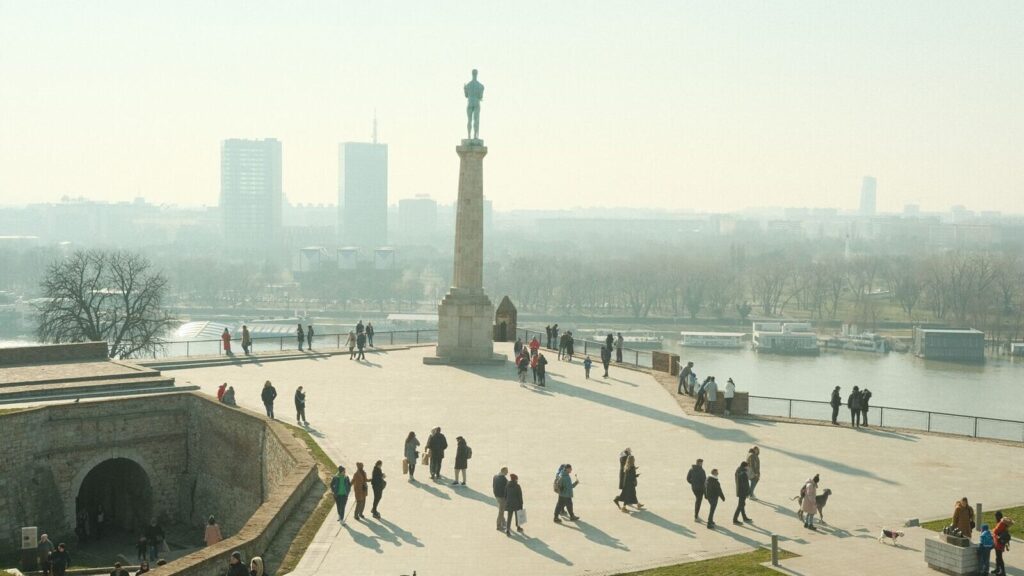
From the Clock Gate, continue toward the Victor monument, known locally as Pobednik. This is the main panoramic stop on the route, where the Sava and Danube confluence, the skyline and the riverbanks come into view.
The monument was created by sculptor Ivan Meštrović and unveiled in 1928. It was originally intended for Terazije Square as part of a fountain, so its present position was not the first plan.
Late afternoon usually offers the warmest light for this part of the walk. For a stronger composition, step back far enough to include both the monument and the wider landscape, then try a second shot without the sculpture.
6. King Gate and Roman Well
Close to the Victor monument are the King Gate and the Roman Well. Even if you do not go inside, this section is worth a short detour because it shows how the ramparts and passages fit into the fortress layout.
The Roman Well is not Roman. The surviving structure dates from the Austrian reconstruction of the fortress in the first half of the 18th century, and a document in Vienna confirms that it was completed in 1731. Access inside depends on opening hours and visitor arrangements.
7. Defterdar Gate and Mehmed Pasha Sokolović Fountain
Continue toward the northwestern rampart and the Defterdar Gate, where the focus shifts from panoramic views to details in the fortress itself. Nearby is the Mehmed Pasha Sokolović Fountain, built in 1576-1577.
The setting has changed over time. What is now a quiet corner once stood in a moat beneath a bridge leading to the main gate of the former castle, which makes this a useful place for understanding how the complex evolved.
8. Despot Gate and Dizdar Tower
The Despot Gate and Dizdar Tower preserve one of the most important medieval parts of the Upper Town. The main medieval entrance stood here, and the gate and northeastern rampart keep an important part of the early 15th-century fortress visible.
This is a good spot to step closer to the stonework, then move back for a wider shot that includes the tower and gate together. After the openness around the Victor monument, this section brings the defensive character of the fortress back into focus.
9. Zindan Gate
After the Despot Gate, continue to the Zindan Gate, one of the most recognisable places in the fortress. Its two massive semicircular towers and the passage between them make it a strong visual stop on the walk.
The gate was built in the mid-15th century to strengthen the eastern approach. A moat and wooden drawbridge once stood in front of it, and its current name comes from the later use of the towers as prisons.
This is one of the best places for a photograph with a person in the frame, because the bridge and towers give a clear sense of scale. Keep the passage free for other visitors while taking pictures.
10. Ružica Church and the Chapel of Saint Petka
From the Zindan Gate area, follow the steps toward Ružica Church and the Chapel of Saint Petka. Ružica is known for its greenery, but the interior is also notable, including chandeliers made from First World War trophy weapons.
Nearby, the Chapel of Saint Petka was built in 1937 above a spring associated with the saint and contains mosaics inside. The atmosphere can be quiet, but services and religious holidays may bring more visitors, so timing matters.
If you have more time
If your schedule allows, continue toward the Lower Town and Nebojša Tower. That extension adds more walking and offers a different perspective on the fortress, with views from below rather than from the upper plateau.
Nebojša Tower can also be visited separately, but it has its own opening schedule. For a shorter visit, it is easier to return through the Leopold Gate and back into the park.
Where to stop for views and breaks
- Broad panorama and the confluence: the plateau around the Victor monument
- A place to rest on a bench: the Sava Promenade
- Gates and towers in one frame: the Zindan Gate
- A stone passage framing the view: the Clock Gate
- Often overlooked details: the Defterdar Gate and Mehmed Pasha Sokolović Fountain
- A slower, quieter section: Ružica Church and the Chapel of Saint Petka, outside busy visiting times
If you only have an hour
Focus on the Stambol Gates, the Clock Gate, the Victor monument, the Despot Gate and the Zindan Gate. That route gives a compact overview of the fortress without requiring indoor visits or the descent to the Lower Town.
If sunset is your priority, plan to end near the Victor monument or the Sava Promenade, where the light and views are strongest.
Practical tips before you go
Wear shoes suitable for stone surfaces, uneven paths and steps. Some parts can be slippery after rain, and exposed plateaus can feel cooler and windier than the rest of the city.
Separate planning is useful for indoor attractions. The Military Bunker and Great Gunpowder Magazine require advance booking for organised visits, while the Roman Well and Nebojša Tower have their own opening schedules.
For many visitors, Kalemegdan works best when it is not rushed. A slower walk lets you see how the fortress is layered, how the rivers shape the view, and why this remains one of Belgrade’s most distinctive places.
Frequently asked questions
How long does the Kalemegdan walk take?
The suggested walk can be completed in around two to three hours at an easy pace.
What are the main attractions in Belgrade Fortress?
Key attractions include the Victor monument, Military Museum, and various historical gates.
Is Kalemegdan suitable for photography?
Yes, there are many scenic viewpoints and architectural details perfect for photography.
What should I wear for the Kalemegdan walk?
Wear shoes suitable for stone surfaces and uneven paths, as some areas can be slippery.