
This article delves into the unique textile tradition of damask weaving in Bezdan, Serbia.
- Bezdan preserves a rich tradition of damask weaving.
- The craft combines local history with practical use.
- Visitors can learn about the intricate weaving process.
In northwestern Bačka, the village of Bezdan preserves a textile tradition that combines craft, local history and practical use. For visitors exploring Serbia beyond the usual routes, damask from this area offers a close look at how a fabric can reflect a place as much as a pattern.
Damask is known for its subtle contrast: the design is woven into the fabric itself, so it appears and disappears depending on the angle of the light. In Bezdan, near Sombor, that technique has been part of the local story for generations.
How weaving took root in Bezdan
A key moment came in 1871, when artistic weaver János Schmidt settled in the village. According to the Tourism Organisation of Vojvodina, his arrival helped develop local weaving and brought in technology that allowed more complex motifs.
After the Second World War, local weavers joined forces and founded the Dunav weaving cooperative in 1951. Its name and structure changed over time, but handweaving remained at the center of the work.
The tradition is also tied to the working life of Bačka. Behind every finished cloth are careful preparation, knowledge of materials and the skill needed to operate the loom. For many visitors, that background is not visible in a shop display, but it is essential to understanding the product.
Patterns begin before the first thread is woven
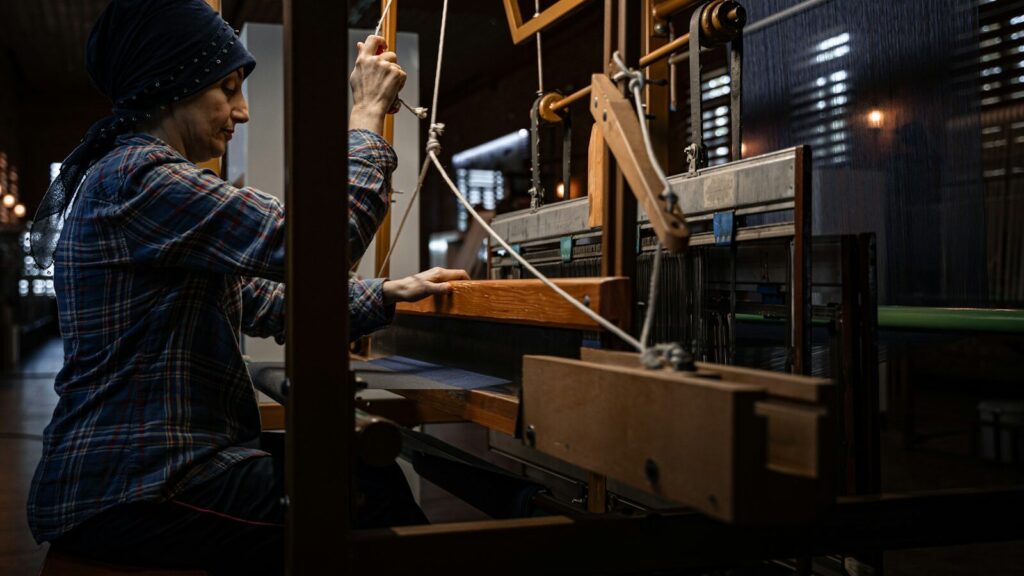
One of the most distinctive features of Bezdan damask is the use of punched cards to control the pattern. Serbia’s National Register of Intangible Cultural Heritage explains that the design is first encoded on cards, which are then linked in sequences. On historic Jacquard looms, this system makes it possible to create different motifs and combinations.
For anyone watching a demonstration, the most interesting part may be the relationship between the cards, the threads and the fabric that gradually appears. It is a reminder that the final cloth depends both on the loom and on the person operating it.
That is why it helps to ask practical questions before a visit: how the loom is prepared, how the pattern is changed and which part of the work requires the most experience. The answers explain much more than a simple estimate of how long one tablecloth takes to make.
What the name does and does not mean
The term silk damask can be misleading, so buyers should check the fibre content. Information published by the workshop through the Sombor crafts association describes a blend of cotton and rayon, sometimes called artificial silk. Cotton damask is also listed among the products. The label on each item should be the final guide.
For travellers, this makes the craft more interesting, not less. A conversation about what the fabric is made of, how it should be washed and what it is meant for is part of the experience of buying a local product.
Recognised as intangible heritage
The skill of handweaving ornamented silk damask using the Jacquard technique was entered into Serbia’s National Register of Intangible Cultural Heritage in 2018. The recognition refers to the knowledge behind the fabric, including how it is made in Bezdan and how that knowledge is passed on.
The register is maintained by the Centre for Intangible Cultural Heritage of Serbia at the Ethnographic Museum in Belgrade. For visitors, that means the value of a finished tablecloth lies not only in its appearance, but also in the process and tradition behind it.
Visiting the workshop
The damask workshop is part of Bezdan’s tourist offer, but published information says visits should be arranged in advance. Before travelling, it is important to confirm the date, availability for individual visitors and whether a live demonstration will be possible.
The public address listed for the workshop is Žrtava fašizma 2, Bezdan. The Tourist Organisation of Sombor can help with contact details and with arranging a visit.
When inquiring, visitors should ask whether their group can be accommodated, how long the visit takes, whether photography is allowed and whether products can be purchased on site. Sales visits and production visits may be organized differently.
What to buy
The published range includes tablecloths, table runners and napkins, as well as made-to-measure options. For visitors who want to take something home, smaller items are often the easiest choice, especially if they are meant for regular use.
Before ordering, it is worth checking current patterns, fibre content, lead times and care instructions. If the item is a gift, the story of where and how it was made can be part of its value.
How to fit it into a day trip
A workshop visit can be combined with time in the latest local travel and culture updates, a walk around Sombor or a short excursion into the countryside around Bezdan. One option is the area near the Karapandža Eco-centre, beside the Bajski Canal in the Gornje Podunavlje Special Nature Reserve.
Before going, check access to the centre, visiting arrangements and trail conditions. On a short day, a confirmed workshop visit, lunch and a walk is enough to make the trip worthwhile.
That is the appeal of Bezdan damask: it offers a souvenir, but also a clearer sense of the work and knowledge that keep a local craft alive.
Frequently asked questions
What is Bezdan known for?
Bezdan is known for its unique damask weaving tradition, which reflects local culture and history.
How is damask fabric made?
Damask fabric is made using a Jacquard loom, where patterns are controlled by punched cards.
Can I visit the damask workshop?
Yes, visits to the damask workshop should be arranged in advance for a guided experience.
What products can I buy from the workshop?
You can purchase tablecloths, table runners, napkins, and made-to-measure options.
What should I know before visiting?
Confirm the visit date, availability, and whether a live demonstration will be possible.